Creative Pipeline
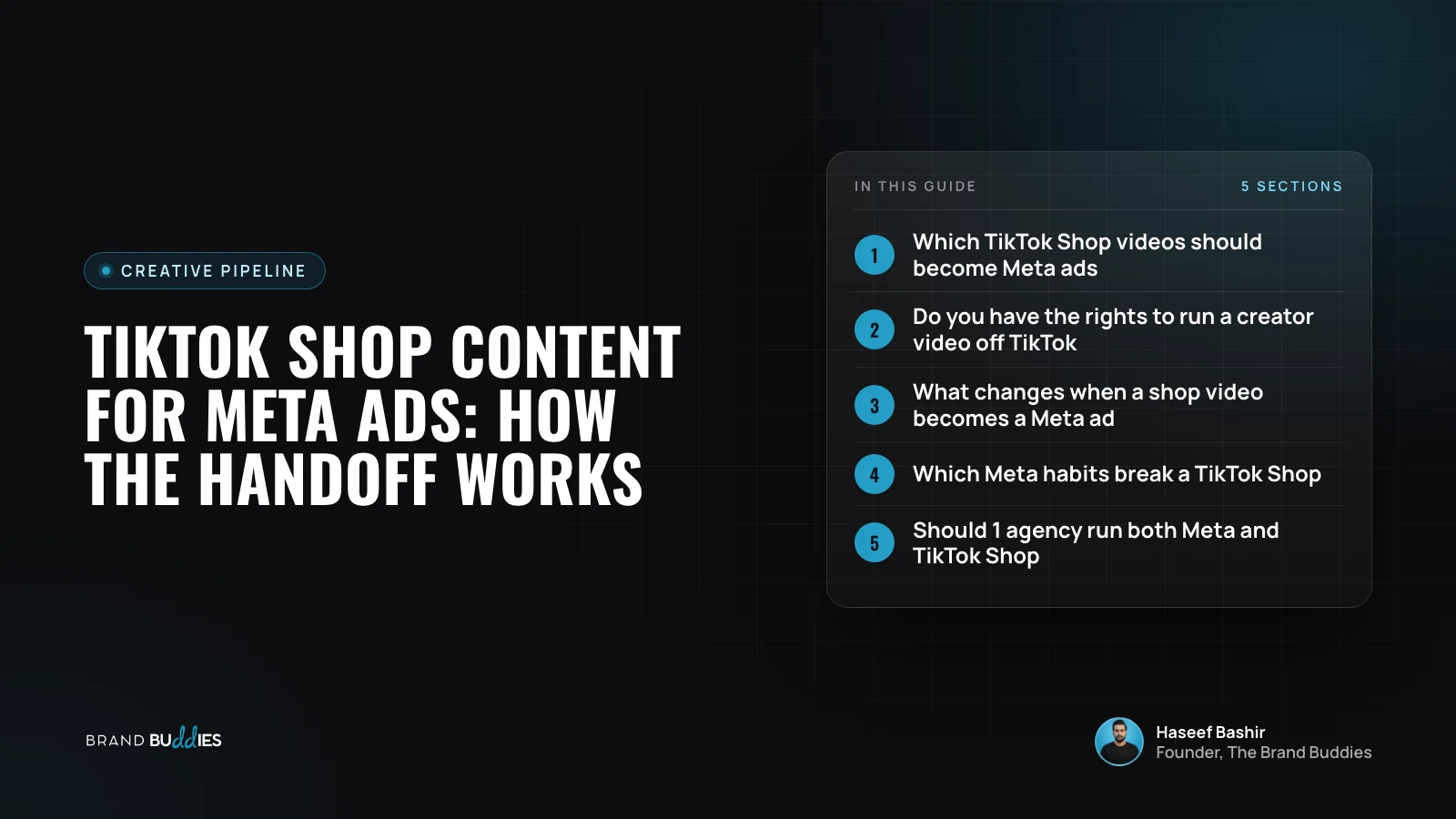
TikTok Shop content for Meta ads: how the handoff works
By Haseef Bashir, Founder of The Brand Buddies. Published November 10, 2026. About a 7 minute read.
A TikTok Shop creator video can run as a Meta ad, but 2 things have to be true: you hold a usage right that covers the placement, and the video has already sold something on organic reach. A Spark Ads authorization code gives you neither. It lets you put budget behind that post inside TikTok, for a window the creator sets, and says nothing about Instagram or Facebook. The sequence we use across 60+ brands and 250,000+ creator videos is the same every time: let creators produce at volume, let the shop tell you which 3 or 4 videos are actually selling, license those, then hand them to whoever buys media elsewhere. We are a TikTok Shop agency rather than a Meta buyer, so this is the supply side view: what we hand over, in what state, and the mistakes that waste the best creative a brand owns.
Which TikTok Shop videos should become Meta ads?
The ones already producing orders on organic reach, not the ones with the most views. A video that sells with no budget behind it has proven its hook, its claim and its offer on a cold audience that had no reason to care. That is a harder pre-test than most paid creative ever gets.
We read that from a 4 question launch analysis on every shop: which creators get views, which creators drive shop clicks, which hooks stop the scroll, and which angles drive sales. They are 4 different lists. Views and orders overlap far less than brand owners expect, and the video a founder loves is rarely the one on the sales list. Patterns usually surface in weeks 3 and 4.
Which exposes the supply problem. Most brands launch with 5 videos and wonder why nothing is moving, and with 5 videos there is nothing to pick from. A launch planned properly runs 40 vetted creators posting 2 to 4 videos a week, which is 80 to 160 videos a week. At that volume the winners announce themselves, and you are choosing the top 2% of a library instead of the best of a handful.
Scale matters here because paid delivery burns creative fast. On Hayley Grace, a US book brand, $89,947 of GMV Max spend returned $339,690 in gross revenue at 3.78x across 21,484 orders, and the dashboards are published. No single video carried that. A pool did, with fresh winners feeding in as earlier ones tired. A brand that wants cross channel creative needs the same engine running underneath.
Do you have the rights to run a creator video off TikTok?
Usually not by default. An affiliate posting your product under a commission agreement has licensed you nothing, and a Spark Ads authorization code only covers paid delivery of that post inside TikTok. Running the same footage on Meta is a separate, written agreement with the creator. This is general guidance, not legal advice.
The operational fix is the same one that works for authorization codes: ask early. We put usage terms in the creator brief at onboarding, before anybody has filmed, because the ask is routine then and awkward the week a video is spiking. A creator who has just gone viral knows exactly what the footage is worth to you.
Be specific about what you are asking for. Which channels the footage may run on. For how long. Whether you may re-cut it or only run it as posted. Whether the creator's handle and face may appear in a placement their own audience will never see. Whether paid usage carries a fee on top of commission, which sits at 15% as a floor and 20% to attract creators who can sell, with 30% to 35% on a hero SKU.
Retainer creators are where this gets easy. Locking your top 3 to 5 performers into an ongoing agreement producing 10 to 30 videos a month means multi channel rights are negotiated once, in a relationship both sides want to keep, rather than chased video by video. Sorting those terms up front is part of what our UGC and content creative team does on every shop. For the TikTok side mechanics, codes, windows and what they do not cover, we wrote up Spark Ads for TikTok Shop separately.
What changes when a shop video becomes a Meta ad?
The destination and the context, not the footage. Inside TikTok Shop the cart is 1 tap away and the product listing closes the sale. On Meta the same video has to carry a stranger to a product page that was never built for cold traffic, so the call to action, the offer and the landing page all need rework even when the edit stays untouched.
Start with the call to action, because it is usually the line that breaks. "Tap the orange cart" means nothing off TikTok. Neither does "check if you have shop coupons", which is one of the most underrated CTAs on the platform and completely unusable anywhere else. If your rights only allow running the video as posted, you have to choose videos whose CTA still makes sense, which quietly shrinks the eligible list.
What travels well is everything that made the video native. The hook in the first 2 seconds, where specificity wins and "Watch what happens to my brows after a 12 hour shift" beats "watch this". The demonstration. The proof. The 6 angles we brief against, transformation, routine integration, problem and solution, personal story, educational, and trend based, all work on a feed that is not TikTok, because they are human formats rather than platform tricks.
What does not travel is the shop machinery. Affiliate attribution, shop coupons and the product card are TikTok features. Keeping the video vertical, phone shot and unpolished is not laziness, it is the whole reason the asset outperforms a studio spot.
Which Meta habits break a TikTok Shop?
Daily optimization is the costly one. GMV Max is not a Meta campaign and does not reward the same hands on management. We leave a new campaign alone for 3 to 4 days while it stabilizes, read it on 5 to 6 days of data, then raise 20% to 30% at a time with 5 to 6 days between steps. Touching it daily resets learning and buys nothing.
The cut rules are mechanical too. A video eating 40%+ of spend at under 1x return after 5 to 6 days goes. A weak one taking under 5% of spend stays, because pruning it costs more attention than the budget is worth. Brands arriving from paid social tend to do the opposite on both counts.
The second habit is sequencing. On Meta you can launch with 1 strong asset and iterate. A shop cannot: our readiness rule is 20 to 30+ videos live before any ad budget goes on at all, because GMV Max pulls across your eligible content pool and a thin pool starves it. Ads switched on before there is content is the single most common reason a launch stalls. If you would rather hand the sequence over, creators first and budget on proven creative is what our TikTok ads and GMV Max team runs daily.
The third is targeting instinct. Audience building is the Meta lever. On TikTok the creative does most of the targeting work, so the hours a media buyer would spend on segments are better spent on which 10 videos go live this week.
Should 1 agency run both Meta and TikTok Shop?
Not necessarily, and it is rarely the question people mean. TikTok Shop is a creator operation: sampling, briefs, a daily community, commissions, affiliate ops. Meta buying is a media operation. One team can hold both, but only where the creator side is staffed as its own function instead of a side task for a media buyer.
That distinction is practical, not territorial. Creator work is a volume of small human jobs. We run 20+ creator communities daily, which is what holds posting rates at 80%+, and sampling is tracked as a line item because 50 active creators at about $13 a sample is roughly $650 every 2 to 3 weeks, repeated for whoever performed. Bonus tiers sit at roughly 10% of GMV on top of commission. None of that looks like media buying, and it does not survive being squeezed in beside it.
So judge the structure by the handoff rather than the org chart. Whoever runs the shop should deliver the winning videos weekly, with the shop data that proves they won, and the usage rights already documented so the media buyer can legally run them. If those 3 things arrive on time, 2 teams work fine. If they do not, 1 team will not fix it.
One honest note on measurement, because it changes how the 2 channels get judged against each other. On platform return undercounts what a shop does, since TikTok Shop is a discovery channel before it is a sales channel. On the 9 figure CPG brand whose shop we run, which did $1,007,726 in GMV in 30 days, the lift carries into Amazon and Shopify too. Blending that into a Meta dashboard is how good creative gets defunded for the wrong reason.
Quick answers
Can you use TikTok Shop creator videos as Meta ads?
Yes, with 2 conditions: a written usage right that covers the placement, and evidence the video already sold on organic reach. A Spark Ads authorization code is neither of those, and it does not extend past TikTok. Ask for multi channel usage inside the creator brief at onboarding, not after a video spikes.
Do Spark Ads authorization codes cover Meta?
No. An authorization code lets you put paid delivery behind an existing TikTok post, under the creator's handle, for a window the creator sets. It is not content rights and it is not permission to re-cut the footage. Running that same video on Instagram or Facebook is a separate agreement with the creator.
Should the same agency run Meta ads and TikTok Shop?
Only if the creator side is staffed as its own function. TikTok Shop is a creator operation: sampling, briefs, a daily community and commissions. Meta is a media operation. What matters more than the structure is that the winning videos, the shop data behind them and the usage rights reach the media buyer every week.
How many videos do you need before any of this works?
Enough that you have winners worth licensing. Most brands launch with 5 videos and wonder why nothing is moving. A launch planned properly runs 40 vetted creators posting 2 to 4 videos a week, which is 80 to 160 videos a week, and we want 20 to 30+ live before any ad budget goes on.
One last thing. Brands tend to treat this as a media question and it is a supply question. The agencies that hand over good cross channel creative are not better editors. They are running enough creators, with rights agreed up front, that there is something worth handing over every single week.
Want a content engine worth repurposing?
Book a strategy call. We will look at your creator pool, your rights position and which videos are already selling, and tell you what deserves budget. If we are not the right fit, we will say so.
Book a strategy call →