Spark Ads
Spark Ads for TikTok Shop: how to run them without burning spend
By Haseef Bashir, Founder of The Brand Buddies. Published November 2, 2026. About a 7 minute read.
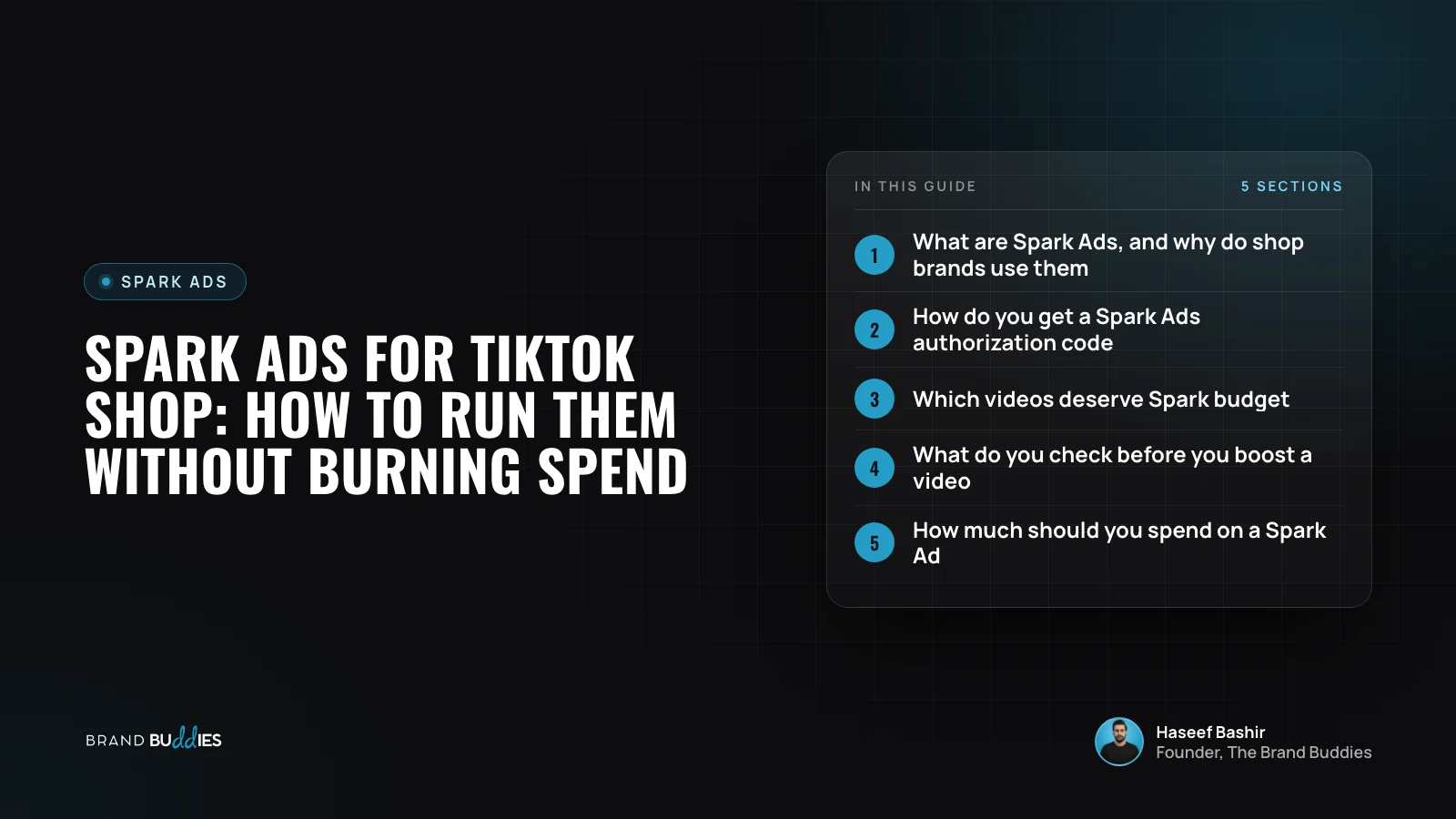
A Spark Ad is a TikTok ad that runs on an existing organic post, yours or a creator's, using an authorization code the post owner grants you. The video keeps its handle, its comments and its likes, and the engagement your budget buys stays on the original post. For a TikTok Shop brand that makes Spark the scalpel rather than the engine: you use it to push 1 video that is already selling, to test a new angle with controlled targeting, or to grow the account before a launch, while GMV Max runs the whole content pool. We are a TikTok Shop agency that has put 250,000+ creator videos through this channel across 60+ brands, and the rule is the same for both formats. The video earns the budget first. Here is how we authorize, pick, fund and judge one.
What are Spark Ads, and why do shop brands use them?
A Spark Ad puts paid budget behind a post that already exists instead of a new ad asset. You need the post owner's authorization code, the ad runs under the creator's handle, and the views, comments and likes it buys land on the original video. That is the whole appeal for a shop: the asset keeps compounding after the campaign stops.
The second reason is simpler. An affiliate video carries a person's face, their audience's comments and their own words about your product. Across 60+ brands, native beats polished on this platform almost every time.
Remember what the asset already cost before you add media spend: a sample, commission on every order it drives, 15% as a floor and 20% to attract creators who can sell, 30% to 35% on a hero SKU, plus bonus tiers at roughly 10% of GMV.
How do you get a Spark Ads authorization code?
The creator generates the code on their own video inside TikTok, chooses how long it stays valid, and sends it to you to paste into Ads Manager. You cannot create one for somebody else's post. TikTok moves the exact menu path and the available windows from time to time, so check TikTok's own Ads Manager help pages for the current steps rather than a blog post.
The operational part is where brands lose videos. Codes expire, and the moment you need one is the moment a video is spiking. So we ask for authorization at onboarding, inside the creator brief, before anybody has posted. Easy ask then, urgent later.
That only works if you can reach creators the same day. We run 20+ creator communities daily, which is also what holds posting rates at 80%+, and a code request in a group chat gets answered in hours instead of never. Keep a record of who authorized what and until when, because nobody remembers in month 3.
One distinction to be clear on: an authorization code is permission to run that post as an ad. It is not content rights, and it is not permission to re-cut the video. If you want the footage for Meta or your own channels, that is a separate agreement, which is part of what our UGC and content creative team sorts out up front.
Which videos deserve Spark budget?
Only videos that are already selling. Not the ones with the most views: the ones producing shop clicks and orders on organic reach alone. Boosting a video that gets views and no orders buys you more views and no orders, at a worse price than the organic reach was giving you.
We read that from a 4 question launch analysis on every shop: which creators get views, which creators drive shop clicks, which hooks stop the scroll, and which angles drive sales. Those are 4 different lists, and the gap between the 1st and the last is where most ad budget dies. Patterns usually show up in weeks 3 and 4.
Which brings up the supply problem. Most brands launch with 5 videos and wonder why nothing is moving, and with 5 videos there is nothing to pick. A launch planned properly runs 40 vetted creators posting 2 to 4 videos a week, which is 80 to 160 videos a week. At that volume the winner is obvious.
What do you check before you boost a video?
The first 3 seconds, the CTA and the listing behind it. You cannot re-edit a Spark post, so the only lever left is whether this video deserves amplification as filmed. A weak hook gets skipped faster when it is paid, and a strong video pointed at a thin listing converts worse when it is paid, because you are buying colder traffic than the organic feed was.
On the hook: specificity wins. "Watch what happens to my brows after a 12 hour shift" beats "watch this", which is why we build 10 to 15 hooks per product into every brief. On the CTA: 2 per video, 1 in the first 3 seconds and 1 at the end. "Tap the orange cart" works, "check if you have shop coupons" is underrated, and "link in bio" is dead on TikTok Shop.
On the listing: a Spark Ad can only sell what the product page converts. Reviews, images, variants and shipping speed decide how many bought clicks become orders. Price matters too, because the TikTok sweet spot sits at $15 to $35 with impulse buying falling away above about $50, and we want 65%+ margin after all platform fees with 50% as the floor.
How much should you spend on a Spark Ad?
Start with a budget you can lose for 5 or 6 days, because that is the window a decision needs. We leave a new campaign alone for 3 to 4 days while it stabilizes, read it on 5 to 6 days of data, then raise 20% to 30% at a time with 5 to 6 days between steps. Daily tinkering is the most expensive habit brands bring over from Meta.
The cut rules are just as mechanical. If a video is eating 40%+ of spend at under 1x return after 5 to 6 days, it goes. If a weak one is taking under 5% of spend, leave it: pruning it costs more than the budget does. Breakeven comes from your own margin, not a published benchmark. The full budget mechanics, pacing and scaling steps are in our GMV Max budget guide, and they apply to a Spark campaign too.
How do you know a Spark Ad worked?
Orders and cost per order first, then the lift in total shop revenue with spend on versus off. Views, likes and saves tell you the post travelled. They do not tell you it sold. The honest test for any TikTok Shop ad is what the shop banked that week against what you put in.
For scale on what disciplined spend looks like: in 1 week on a US wellness brand we spent $2,600 and booked 314 orders, $8.28 of ad cost per order, returning $13,129 at 5.05x. Treat that as a shape, not a forecast. Return moves with price, margin and category, and we do not promise a number.
2 traps are worth naming. Platform attribution sweeps in sales your creators and organic reach were already producing, so a flattering dashboard is not proof of lift. And on-platform return undercounts in the other direction, because TikTok Shop is a discovery channel: on the 9 figure CPG brand whose shop we run, the lift carries into Amazon and Shopify too.
Spark Ads or GMV Max: which one runs your shop?
GMV Max runs the shop. Spark Ads handle the jobs it cannot do. Our readiness rule is 20 to 30+ videos live before any ad budget goes on at all, then GMV Max on the proven pool as the always on engine, then Spark for a breakout video, a controlled creative test, or account growth before a launch.
GMV Max gets the engine job because of coverage. It pulls across your whole eligible content pool with no per video codes to chase. On Hayley Grace, a US book brand, $89,947 of GMV Max spend returned $339,690 in gross revenue at 3.78x across 21,484 orders, and the dashboards are published. Spark would never have scaled that, because you would still be collecting codes.
Spark earns its place where control is the point: 1 video that deserves a dedicated push, a new angle tested on a defined audience, or an objective GMV Max does not optimize for, like followers or traffic somewhere other than your shop. The format by format comparison, including why the 2 dashboards disagree, is in GMV Max vs Spark Ads. If you would rather hand the sequence over, creators first and ads on proven creative is what our TikTok ads and GMV Max team does every day.
Quick answers
What are Spark Ads on TikTok Shop?
A Spark Ad is a TikTok ad that runs on an existing organic post instead of a new ad asset. You need an authorization code from whoever owns the post, the ad keeps the creator's handle, comments and likes, and the engagement your budget buys stays on the original video, so it keeps working after the campaign stops.
Do you need a creator's permission to run a Spark Ad?
Yes. The creator generates an authorization code on their own video and sends it to you, and the code stays valid for a limited window. You cannot boost somebody else's post without it. We ask for authorization during creator onboarding rather than after a video takes off, because the ask is easy then and urgent later.
Are Spark Ads better than GMV Max for TikTok Shop sales?
For always on shop sales, no: GMV Max runs your whole content pool and needs no codes. Spark Ads are the precision tool for jobs GMV Max does not do, like pushing 1 breakout video, testing an angle with controlled targeting, or growing the account before a launch. Most shops we run use both, split by job.
Which video should I boost with a Spark Ad?
The one already producing shop clicks and orders on organic reach, not the one with the most views. We read that from the launch analysis: which creators get views, which drive shop clicks, which hooks stop the scroll and which angles drive sales. Patterns usually show up in weeks 3 and 4.
One last thing. The brands that win with this format are not the ones with the best targeting. They are the ones who can boost a spiking video within the hour, because the code was already in the folder.
Want your winning videos found and funded weekly?
Book a strategy call. We will look at your content pool, your margins and which videos are already selling, and tell you what deserves budget. If we are not the right fit, we will say so.
Book a strategy call →