Contract Guide
TikTok Shop agency contract: what to check before you sign
By Haseef Bashir, Founder of The Brand Buddies. Published October 27, 2026. About a 7 minute read.
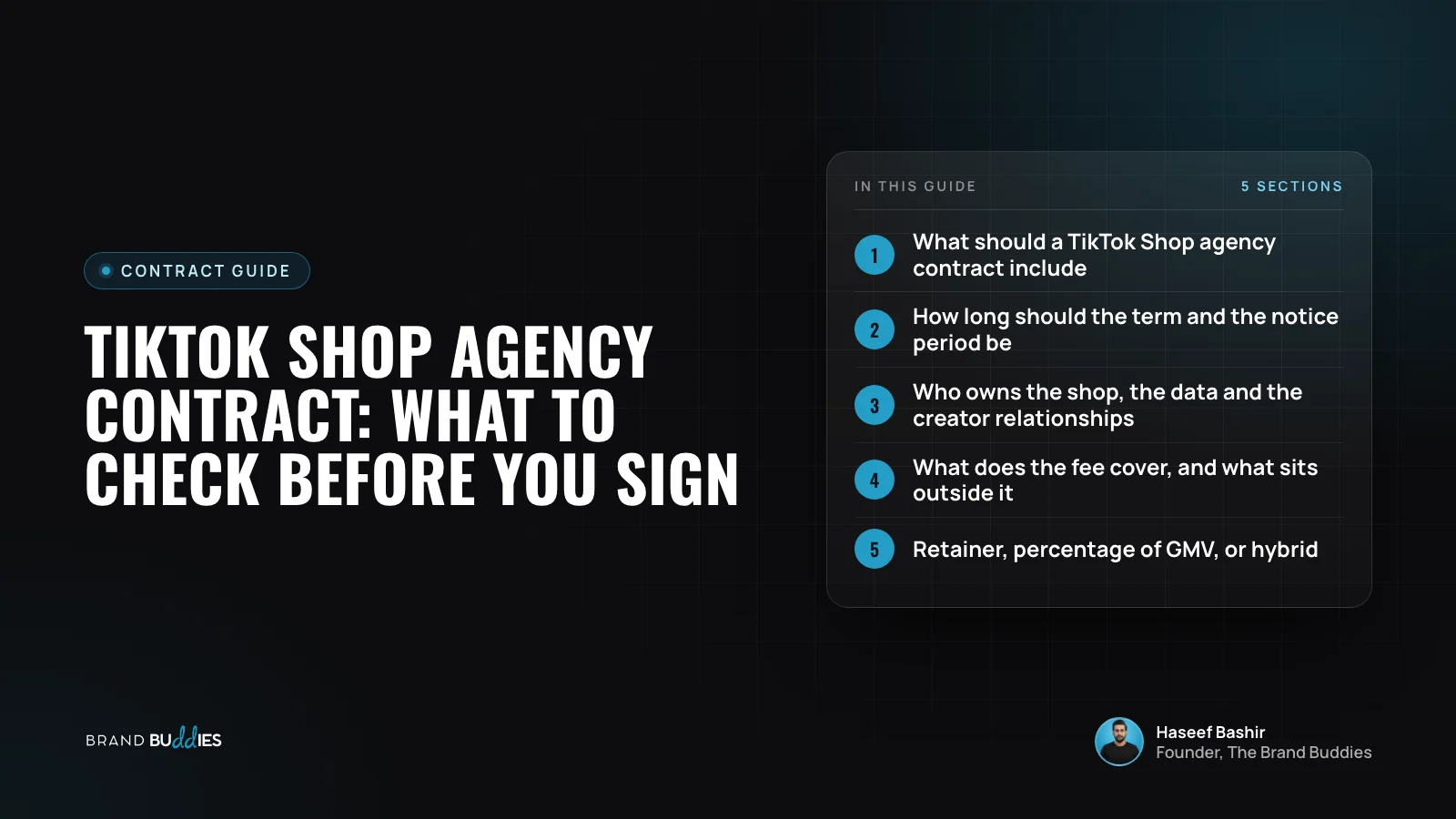
A TikTok Shop agency contract should settle 6 things before you sign: the term and the notice period, who owns the shop and the data, what the monthly fee covers, which costs sit outside it, how often you get reported to, and what happens to your assets on the way out. Settle those and the paperwork becomes boring, which is what a good contract is. Leave 1 of them vague and you find out 8 months later, usually when your creator list turns out to live in somebody else's spreadsheet. We run a TikTok Shop agency ourselves, so read this knowing where we sit: our pricing runs from $2,500 to $10,000 a month, we give the exact number on the call, and we expect to earn the next month, every month. Across 60+ brands and $20M+ in GMV, the clauses that caused problems were almost never the ones brands negotiated hardest over. This is operational guidance, not legal advice.
What should a TikTok Shop agency contract include?
6 sections, in plain language: term and notice, ownership of the shop and the data, scope of the monthly fee, the costs that sit outside it, reporting cadence, and exit and handover. Everything else is boilerplate your lawyer handles. These 6 decide whether the relationship is survivable, because TikTok Shop work builds assets that are easy to misplace: a creator roster, a sample history, commission terms, authorized video content, an ad account structure. All of it walks out with an agency that was never told it could not take it.
How long should the term and the notice period be?
Long enough to build, short enough to leave. Most brands see meaningful order volume in the first 60 to 90 days once creators and ads are live, so a term shorter than that judges work that has not landed yet. A term much longer than that, with no proof behind it, is a lock-in dressed up as a ramp.
Our published position is 1 line: we expect to earn the next month, every month. An agency that needs a long lock-in to keep you is telling you something. Teams confident in the 3rd month do not need the 12th month written into the paperwork.
Then read the notice clause, because it is where short terms get quietly undone. Check 3 things: how many days of notice, whether notice can only be given at certain points in the cycle, and whether the work continues through the notice period you are paying for. A month to month deal with a long notice window is not month to month.
Who owns the shop, the data and the creator relationships?
Your brand, and the contract should say so without hedging. Our own answer, published on our TikTok Shop management page, is that the shop, the data and the creator relationships stay with your brand, we run them for you, and we hand everything over cleanly if we ever part ways.
Name the 4 assets separately, because an agency can concede 1 and keep the others. The shop, including owner level access in Seller Center. The data: orders, buyers, affiliate reporting. The creator relationships: the roster with handles, commission rates, sample history and who drives GMV. And the content rights.
Content rights are the one most brands skip. The creator videos carrying your listings and feeding your ads were made under terms somebody agreed to, and if nobody wrote them down you find the gap when the ads stop running. Ask which videos you can keep using after the relationship ends, under whose authorization, and for how long. The same question applies to anything we produce through our affiliate and creator program.
The honest caveat: a roster transfers as a file, a relationship does not transfer at all. We run 20+ creator communities daily, and the trust inside them belongs to whoever shows up in the chat. Ownership clauses protect the data. Only continuity protects the momentum.
What does the fee cover, and what sits outside it?
The fee covers the team's time. It should not cover creator commission, samples, bonuses or ad spend, and nobody should be marking those up. Make the contract list them as pass through costs, because the gap between a fee and a fee plus the channel costs behind it is what kills budgets in month 2. The 4 that sit outside it on every shop:
- Creator commission, 15 to 20 percent of every affiliate sale. Set it below 15 percent and quality creators promote somebody else's product. Hero SKUs often sit higher.
- Samples and shipping. 50 active creators at about $13 a sample is roughly $650 every 2 to 3 weeks. The contract should say who pays and who decides.
- Performance bonuses, roughly 10 percent of creator driven GMV. Tiered on top of commission, and the highest leverage spend in the system.
- Ad budget for GMV Max. Yours, in your ad account, scaled 20 to 30 percent at a time. We do not switch GMV Max on until 20 to 30+ videos are live, so the ad line starts later than the retainer.
On scope, write down what the fee buys in outputs rather than adjectives: creators activated per month, briefs delivered, videos live, campaigns managed. A retainer with no defined deliverables is the most expensive clause in the document. The line by line breakdown sits in our guide to TikTok Shop agency pricing.
Retainer, percentage of GMV, or hybrid?
Each suits a different stage, and the contract should match the stage you are in, not the one the agency prefers. Most full service teams charge $3,000 to $10,000+ a month as a flat retainer, a percentage of GMV of commonly 10 to 20 percent, or a hybrid of a smaller retainer plus a performance percentage. Hybrids suit shops with consistent volume.
A flat retainer is the honest structure for a cold start, because the first 30 to 60 days are building work and a percentage of nothing pays the agency nothing. Percentage of GMV aligns incentives once revenue exists, with 2 caveats. Percentage deals on a shop doing zero revenue attract agencies that sign many brands cheaply and wait to see which pop. And the math flips at scale: 15 percent of a $200K month is $30K, more than the best retainer on the market, so cap it or step it down by band.
Whichever you pick, add 1 question: is there any markup on ad spend or samples? A quiet margin there is the most misaligned incentive in this business, and it never appears on a pricing page.
What should the reporting clause say?
Name a cadence and name the metrics. Weekly, with GMV, orders and return on ad spend, which creators and videos drove the sales, and what is being scaled or cut next. A monthly PDF reporting views is not reporting, and the contract is where you stop that becoming a habit.
Tie it to access as well as documents. You should be able to open your own Seller Center and check the same numbers any time, which means owner level access from day 1, not a dashboard somebody screenshots for you. Our standard is weekly reporting plus roughly 30 minutes a week of the brand's time, and the rest of the vetting questions are in how to choose a TikTok Shop agency. Add 1 more line: how many brands the account team carries at once. We cap ours at 10 to 15.
What should the exit and handover terms actually say?
That the agency keeps working through the notice period and hands over a specific list on a specific date: access transferred, affiliate data exported, open collaborations documented at their current commission, sample history passed on, content authorizations confirmed in writing. Vague goodwill about a smooth transition is not a handover clause.
The cost of a bad exit is paid in sales, not in court. Open collaborations, samples in flight and live GMV Max campaigns are what produce orders, and the brands that dip during a switch are the ones where somebody paused all 3 on day 1 of the notice period. A clause that keeps the engine running beats a penalty clause that pays you after it stops.
We have taken over live shops mid flight, and our audit step exists for this reason: map the hero products, the posting creators and the samples already out before pausing anything. The dashboards behind those takeovers sit in our case study pack. Judge any agency on how precisely it describes a handover it has run, in both directions.
Quick answers
What should be in a TikTok Shop agency contract?
6 things: the term and the notice period, ownership of the shop, the data, the creator relationships and the content rights, what the monthly fee covers, which costs sit outside it, the reporting cadence, and the exit and handover terms. Whichever of those 6 is vague in the document is the one that bites you later.
How long should a TikTok Shop agency contract last?
Long enough to build, short enough to leave. Most brands see meaningful order volume in the first 60 to 90 days, so a term shorter than that judges work which has not landed yet, and a term much longer is a lock-in dressed up as a ramp. Our published position: we expect to earn the next month, every month. An agency that needs a long lock-in to keep you is telling you something.
Who owns the TikTok Shop if an agency manages it?
Your brand should. The shop, the data and the creator relationships stay with your brand, and the agency hands everything over cleanly if you ever part ways. Get that in writing, and add content rights next to it: which creator videos you can keep running as ads once the relationship ends, and for how long.
What costs sit outside a TikTok Shop agency fee?
4 of them, and none are small. Creator commission of 15 to 20 percent on every affiliate sale, product samples, which run about $650 every 2 to 3 weeks for 50 active creators at $13 a sample, performance bonuses of roughly 10 percent of creator driven GMV, and your own ad budget for GMV Max. The contract should state plainly that none of these are marked up.
The bottom line
A contract cannot make an agency good. It can only stop a bad month turning into a bad year, and stop the assets you paid to build leaving with somebody else. Read the 6 sections, ask the awkward questions on the call rather than after it, then judge the work monthly.
Want the scope and the number before the paperwork?
Book a strategy call. We will run your margins against every cost in this article, scope the work, and give you the exact number. If we are not the right fit, we will say so.
Book a strategy call →