Platform Trust
Is TikTok Shop legit, for sellers and for buyers?
By Haseef Bashir, Founder of The Brand Buddies. Published November 3, 2026. About an 8 minute read.
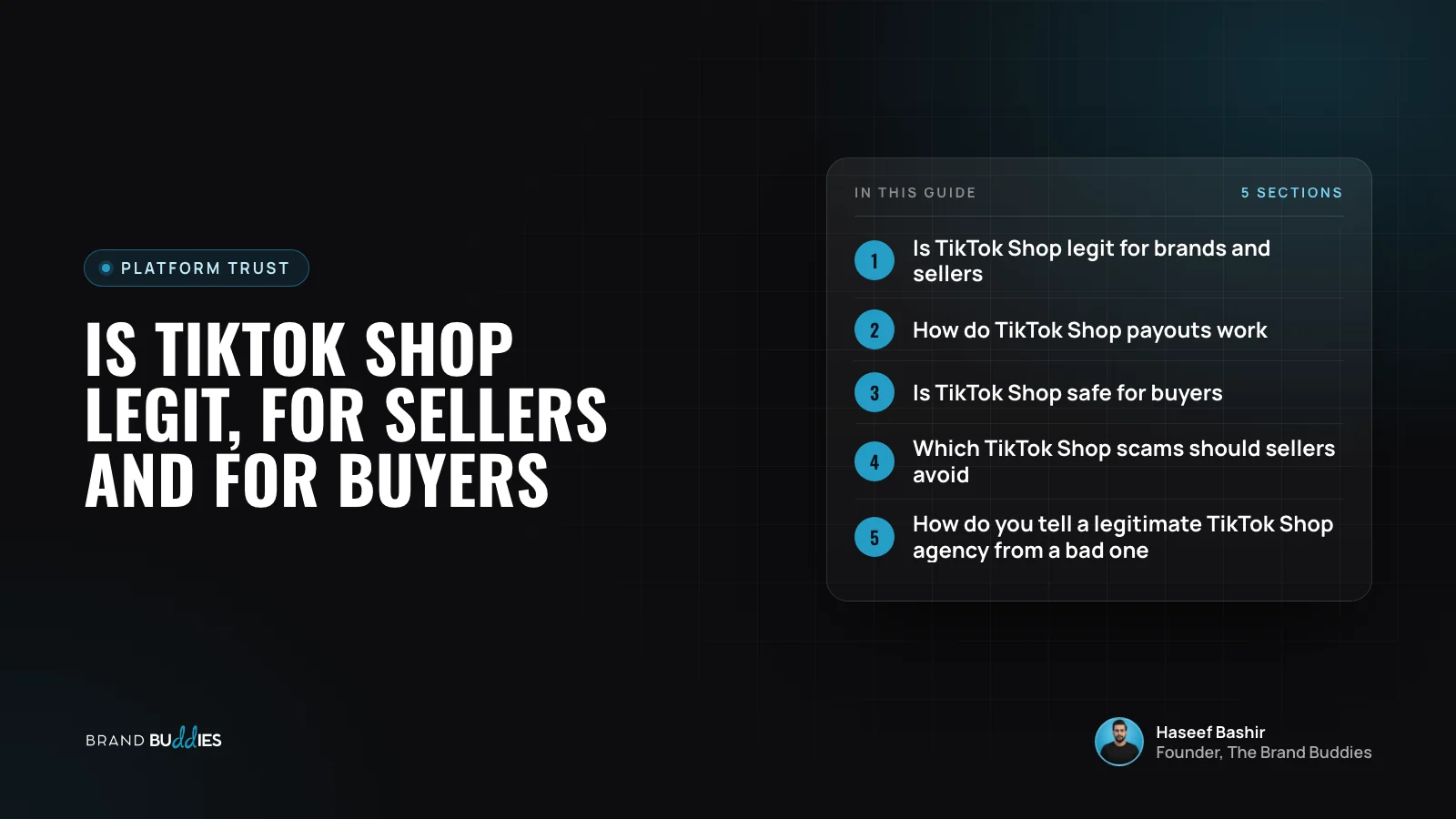
Yes. TikTok Shop is TikTok's own marketplace, with in-app checkout, order tracking, buyer protection and seller payouts that land in a verified bank account. We are an official TikTok Shop Partner agency and we work inside these shops every day: 60+ brands scaled, $20M+ in GMV driven, 250,000+ creator videos published. One shop we run, a 9 figure CPG brand, did $1,007,726 in GMV on 29,646 orders in 30 days, and that money settles like any marketplace settles. What is not always legitimate is the service layer that has grown up around the platform: agencies promising guaranteed GMV, accounts that farm samples and never post, and sellers of views and followers. The platform is sound. The scams sit next to it. Here is how both sides work, for a brand and for a buyer.
Is TikTok Shop legit for brands and sellers?
It is a working sales channel, not a side experiment. TikTok Shop operates in the US and the UK, you register as a business with documents TikTok verifies, you list products, buyers check out without leaving the app, and TikTok collects the money and settles it to you. Brands sell at scale on it daily.
The proof we can show is our own order data. A UK wellness brand we run, Ancient Remedies, went from a shop doing roughly a thousand a month to over half a million in gross sales across 151 days, 16,441 orders from 16,322 buyers. The 9 figure CPG brand above closed its 1st month with us at $65,459 in GMV on 1,322 orders, and reached $1M+ a month by month 4. Those are orders shipped and settled, not pledges.
So the honest caveat is not about legitimacy. It is that TikTok Shop pays out to brands that feed it content. A shop with a clean catalog and no creator videos does almost nothing, which is why most brands who decide the channel is fake simply launched with 5 videos and waited. The platform works. It is the engine behind it that most sellers never build.
How do TikTok Shop payouts work?
The buyer pays TikTok, not you. TikTok holds the money until the order is delivered and the return window clears, takes out its own fees and the creator commission on that order, then settles the balance to your bank account on a published schedule. Nothing is invoiced and nothing depends on a creator paying you.
Settlement timing, fee rates, reserve rules and the payout cycle differ by market and TikTok changes them, so take those numbers from TikTok's Seller Center rather than from any agency's summary, including ours. What we can tell you is what the deductions look like in practice, because they are the part that surprises brand owners:
- Creator commission. 15% is the floor, 20% is what attracts quality creators, and 5% to 10% gets you the bottom tier. It comes off the order before you see it.
- Samples. A program of 50 active creators at about $13 a sample runs around $650 every 2 to 3 weeks. Track it as a line item, because it never shows up in a payout report.
- Bonuses. Performance tiers on top of commission land at roughly 10% of GMV when they are working as intended.
That is why we hold products to 65% margin after all fees, with 50% as the absolute floor. GMV is what the shop sold. It is not what you keep, and a brand that treats the 2 as the same number concludes a legitimate channel is a scam when it is just underpriced.
Is TikTok Shop safe for buyers?
For most purchases, yes. Payment, tracking, returns and refunds all run inside the app under TikTok's buyer protection terms, and because the platform holds seller funds until delivery, a seller who ships late or misdescribes a product has something to lose. The specific windows and conditions are TikTok's and they change, so check TikTok's own buyer protection pages for the current version.
What buyers get wrong is treating a creator video as a review. It is an ad, paid on commission. The checks that take 10 seconds: look at the seller rating, read the product reviews rather than the comments, and see whether the shop sells 1 trending item or a catalog it stands behind.
This matters to sellers more than it looks. A video that oversells gets the order and then the return, and returns come straight out of the margin above. It is the reason our creator briefs are built around a demo, the problem and the proof rather than a promise: the video has to show the product doing the thing. Our content direction is mostly this, keeping claims inside what the product can deliver on camera, because a return cancels the order it came from.
Which TikTok Shop scams should sellers avoid?
4 come up again and again across the shops we run. None of them involve TikTok itself. They involve people selling you a shortcut, or people taking your product. Learn the shape of all 4 once and they become easy to spot in a cold DM.
- Login and verification scams. A message claiming to be TikTok support asks for your password, a 2 factor code, or a payment to unlock or approve your shop. TikTok does not do that. Support happens inside Seller Center, and an agency gets access through permissions on its own account, never a shared password.
- Sample farming. Open collaboration lets any creator who meets your minimum request a sample. Some are collecting product, not filming. The controls are built into the affiliate center and most brands miss them: cap the open collab sample count, restrict which SKU variants are claimable, and pause sampling without closing the collab. We only resample creators who performed, and a daily WhatsApp community is what keeps posting rates at 80% or higher instead of chasing people who went quiet.
- Bought views, viewers and accounts. Guaranteed views, paid LIVE viewers and bulk affiliate accounts are sold hard to new shops. They move a vanity number and not a single order, and we broke down each version in our piece on buying TikTok views for a TikTok Shop.
- Guaranteed GMV. Nobody can guarantee a GMV figure, because nobody controls which videos the feed picks up. An agency quoting a guaranteed number is either about to buy engagement to hit it, or about to blame your product in month 2.
How do you tell a legitimate TikTok Shop agency from a bad one?
Check 4 things: official TikTok Shop Partner status, who owns the shop when you leave, what the fee covers, and how short the exit is. The shop, the data and the creator relationships should stay with the brand. Get that in writing before any access changes hands.
Our own stance is published and we will repeat it here: we expect to earn the next month, every month. An agency that needs a long lock-in to keep you is telling you something. Our pricing runs from $2,500 to $10,000 a month, with the exact number set on the call, and we cap the client list at 10 to 15 brands at a time so every shop has someone inside it.
Then make them show the work. Ask for dashboards on the 1st call, ask for reporting weekly in orders and GMV rather than views, and ask when ads get switched on. The correct answer to that last one is after 20 to 30+ videos are live, because paid spend amplifies proof instead of creating it. The longer version of this vetting, with the questions we would ask in your position, is in how to choose a TikTok Shop agency, and what the ongoing work covers is laid out on our TikTok Shop management page.
What does a legitimate TikTok Shop look like in month 1?
Flat, and that is the part nobody warns you about. Weeks 1 and 2 look boring while creators are recruited, briefed and sampled. Weeks 3 and 4 are when content quality jumps and the 1st organic sales land. Month 2 is GMV Max and bonuses. Month 3 and beyond is where it compounds.
We publish that timeline because it is the honest version, and because brands who expect it do not panic in week 2 and pull the plug on a channel that was working. The 9 figure CPG brand took 4 months to go from $65K to $1M+ a month, with every checkpoint along the way on its case study page. The volume math underneath it is unglamorous: 40 vetted creators posting 2 to 4 videos a week is 80 to 160 videos a week, which is the kind of input a feed actually responds to. That recruiting and community work is our affiliate and creator program, and it is the difference between a shop that looks fake and a shop that sells.
Quick answers
Is TikTok Shop legit?
Yes. TikTok Shop is TikTok's own marketplace in the US and the UK, with in-app checkout, order tracking, buyer protection and seller payouts to a verified bank account. We operate shops on it every day, including one doing $1,007,726 in GMV on 29,646 orders in 30 days. The scams sit around the platform, not inside it.
Do TikTok Shop sellers actually get paid?
Yes. The buyer pays TikTok, TikTok holds the money until the order is delivered and the return window clears, deducts its own fees and the creator commission, then settles the balance to your bank account. The current schedule, fee rates and reserve rules are published in Seller Center and they change, so check there.
Is it safe to buy from TikTok Shop?
For most purchases, yes. Payment, tracking, returns and refunds all run inside the app under TikTok's buyer protection terms, and the platform holds seller funds until delivery. Treat the video as an ad rather than a review: check the seller rating and the product reviews before you tap the cart.
How do I avoid TikTok Shop agency scams?
Ask for Partner status, dashboards on the 1st call, and weekly reporting in orders rather than views. Get it in writing that the shop, the data and the creator relationships stay with you. Nobody needs your password, because agencies work through permissions. Treat guaranteed GMV and long lock-ins as warning signs.
The platform is not the risk
TikTok Shop is a settled, audited sales channel with buyer protection on 1 side and verified payouts on the other. The risk in this channel has never been TikTok. It is the shortcut sellers, the sample farmers, and the agencies that need a 12 month lock-in to keep a client. Check the people, not the platform, and build the creator engine first.
Want your TikTok Shop run by a verified Partner?
Book a strategy call. We will show you the dashboards, the margins we would hold your products to, and exactly how we would launch your shop.
Book a strategy call →